



If you've ever picked up two chef knives that look nearly identical but feel completely different in your hand, you've already felt the difference between forged and stamped. One feels like a tool. The other feels like a tool that's trying too hard to look like one.
The terms get thrown around a lot in kitchen knife marketing, but most of it is vague. "Forged" sounds premium. "Stamped" sounds cheap. That's mostly true, but it's not the whole story, and knowing why it's true will make you a much smarter knife buyer.
Here's what actually separates a forged knife from a stamped one, how to tell which one you're holding, and which is worth your money.
What is a forged knife?
A forged knife starts as a single bar or billet of steel that's heated until it's soft enough to shape, then hammered, by hand, machine or by press, into the rough form of a blade. This process refines and aligns the steel's internal grain structure, which combined with precise heat treatment gives forged blades their strength, edge retention, and durability.
Traditional forging is slow and methodical even with drop forging and mechanical hammers. A bladesmith heats the steel, hammers it toward shape, reheats it, and repeats the cycle dozens of times before the blade is even close to finished. After forging comes heat treatment (hardening and tempering), grinding, and hand-finishing — each step done individually, blade by blade.
This is why forged knives are heavier at the bolster, better balanced, and typically full tang, meaning the steel runs the entire length of the handle rather than stopping at a thin tang inserted into the grip.
What is a stamped knife?
A stamped knife is cut from a flat sheet of pre-rolled steel, the same way a cookie cutter cuts dough. A die punches the blade shape out of the sheet, it's ground and sharpened, and a handle is riveted or bonded on.
Stamped blades skip the grain-refining hammer work entirely. That makes them faster and dramatically cheaper to produce. A single press can stamp out thousands of blanks a day, compared to the hours a bladesmith spends on a single forged blade.
Stamped knives aren't automatically bad. Many solid mid-range kitchen knives are stamped, and modern stamped blades have improved a lot. But they start from a structural disadvantage that no amount of grinding or polishing fully corrects.
Forged vs. stamped: the real differences
-
Weight and balance: Forged knives are heavier near the handle, which shifts the balance point back toward your hand instead of out toward the tip. That balance is what makes a forged chef knife feel controlled during long prep sessions, rather than tip-heavy and tiring.
-
Edge retention: The hammering process in forging refines the steel's grain structure. That finer, more uniform grain paired with proper heat treatment holds a sharper edge longer and resists chipping and rolling better than a blade cut straight from sheet steel without being forged.
-
Durability: A forged, full-tang blade is structurally a single piece of steel from tip to butt cap. There's no weak point where a thin tang meets the handle, which is usually where stamped knives eventually fail.
-
Feel in the hand: This is the part that's hard to describe until you've used both. A forged knife has a density and a "planted" feel through the bolster. A stamped knife, even a good one, tends to feel light and slightly hollow by comparison.
Cost: One of the biggest differences between forged and stamped knives is the manufacturing process.
Forged knives require significantly more time, skilled craftsmanship, and labor. Each knife is made from a single heated billet of steel that is hammered and shaped before being carefully finished by hand. This process results in a stronger, more durable blade, but it also increases production costs.
Stamped knives, on the other hand, are cut from a flat sheet of steel using machines, making them much faster and less expensive to produce.
Here are the key differences between forged and stamped knives:
-
Structure: Forged knives are crafted from a single heated billet of steel, while stamped knives are die-cut from a flat sheet of steel.
-
Tang: Forged knives typically feature a full tang for added strength and balance, whereas stamped knives often have a partial tang.
-
Balance: Forged knives are generally have balanced weighted, offering better control and comfort, while stamped knives are lighter with a blade-forward balance.
-
Edge Retention: Forged knives usually provide better edge retention due to their refined grain structure and precise heat treatment, whereas stamped knives tend to lose their edge more quickly.
-
Production Time: Creating a forged blank can take multiple blows and longer time per blade, while a stamped knife can be produced in just seconds.
-
Typical Price: Because of the craftsmanship involved, forged knives are typically more expensive, while stamped knives are a more budget-friendly option.
How to tell if a knife is forged or stamped
You don't need a lab to figure this out. A few quick checks will tell you almost everything:
-
Look for a bolster. That thick collar of steel between the blade and handle on most forged knives is a natural by-product of the forging process. It's much harder and more expensive to fake on a stamped blade, so most stamped knives skip it entirely.
-
Check the weight distribution. Hold the knife loosely at the bolster with two fingers. A forged knife should balance close to that point. A stamped knife usually tips forward, toward the blade.
-
Look at the tang. If you can see the handle steel extend through the handle scales riveted onto a visibly thin strip of metal, it's a partial tang, and a strong sign of a stamped blade.
-
Tap test. Forged blades tend to produce a deeper, denser ring when tapped; stamped blades sound thinner and higher-pitched. It's subtle, but noticeable once you've compared a few.
Why forged knives cost more (and whether it's worth it)
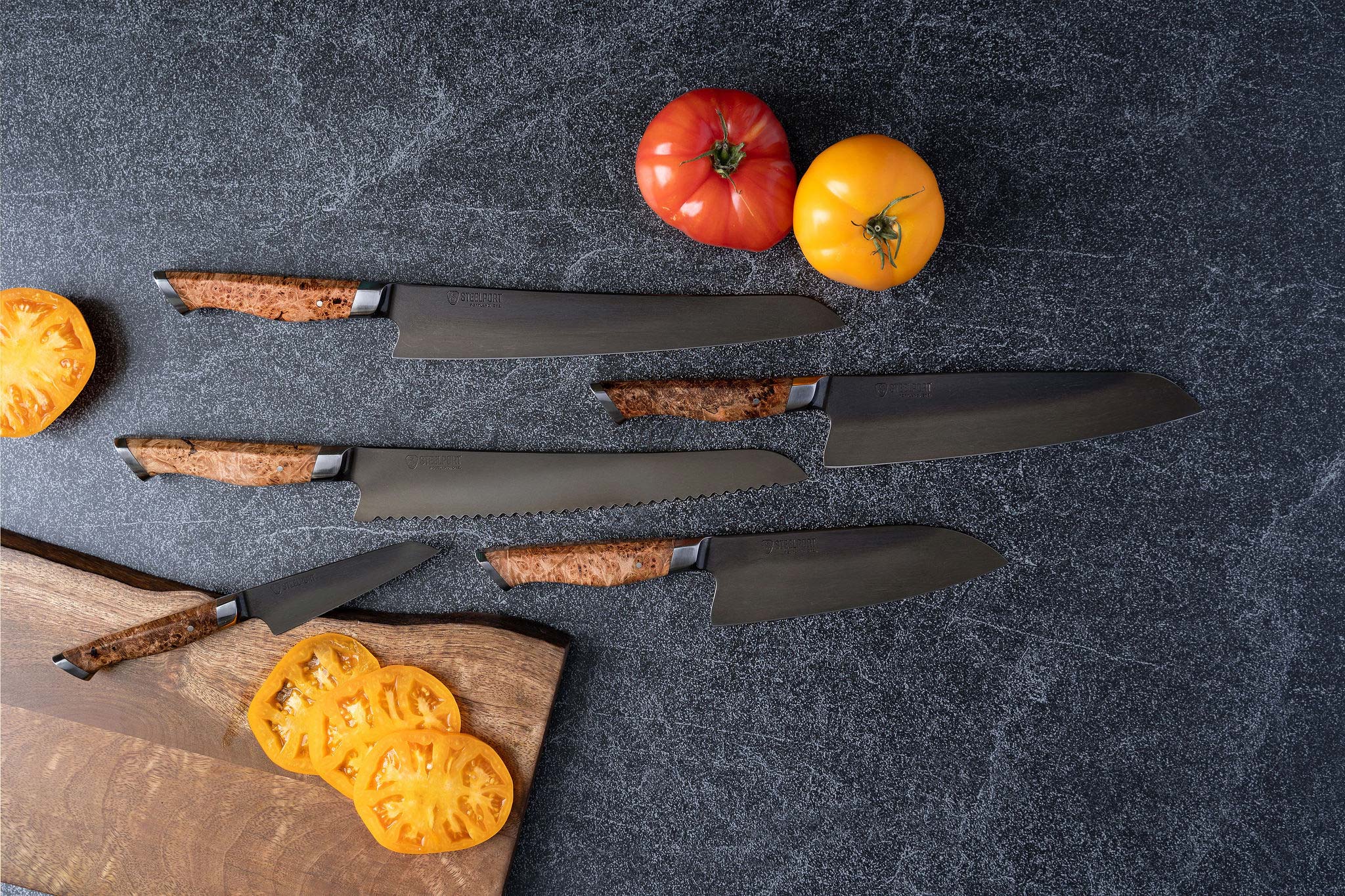
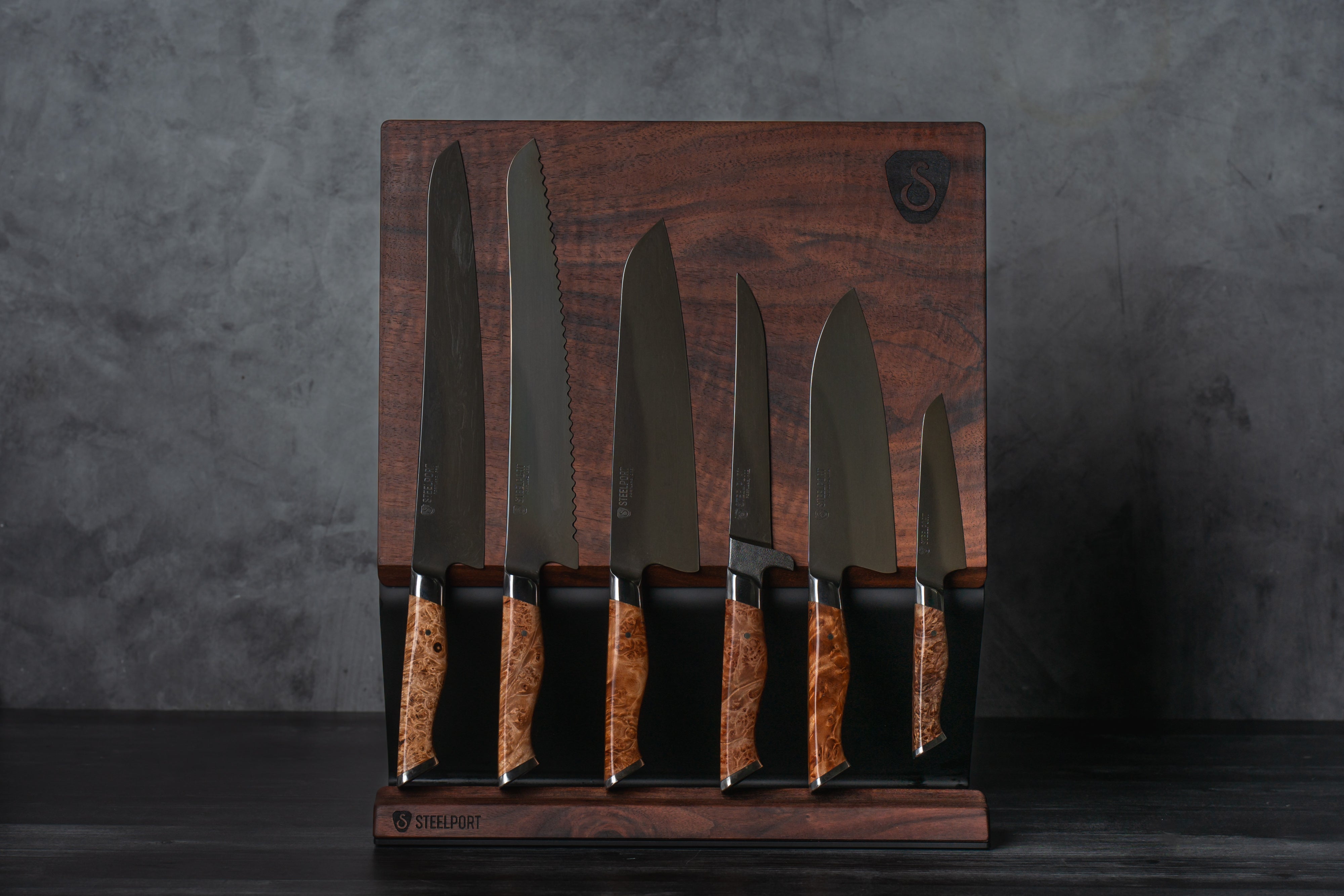
A forged knife isn't more expensive because of branding. It's more expensive because of labor. Every STEELPORT™ Knife Co. blade, for example, is drop forged and then processed in our Portland, Oregon workshop from a single billet of American 52100 carbon steel. The blades are individually heat-treated though a proprietary 8-step heat treatment process to a market-leading 65 HRC hardness at the edge before it's ground, polished, and finally sharpened by hand. That's 134 steps and many hours of skilled work per knife, not seconds on a die press.
Whether that's "worth it" comes down to how you use a knife. If you cook occasionally and want something serviceable, a good stamped knife will do the job. If you're prepping food daily, care about how a knife performs after five years instead of five months, or simply want a tool that's made the way kitchen knives were made for centuries, forged is the difference you'll feel every time you pick it up. Our own 8" Chef Knife is a full-tang forged blade designed specifically to make that difference obvious in the first few cuts.
STEELPORT Knife Co.
Address: 3602 NE Sandy Blvd, Suite B, Portland, OR 97232, United States
Phone: (503) 498-8132
Email: hello@steelportknife.com
Website: https://www.steelportknife.com/
FAQs
Is a forged knife always better than a stamped knife?
Almost always in terms of performance and lifespan, but not always in terms of value. A quality stamped knife can be a perfectly reasonable everyday tool. The quality of a knife also depends on factors like heat treatment, design, and handle material. A forged knife through a great heat treatment is the better investment if you cook often, value your meal preparation experience and want something that lasts decades rather than years.
How can I tell if my current knife is forged or stamped?
Check for a bolster (common on forged knives, rare on stamped ones), feel where the weight balances, and look at the tang where the blade meets the handle. A full, visible tang running through the handle is a strong sign of forging.
Do forged knives need more maintenance than stamped knives?
Not more, just different, if they're also carbon steel rather than stainless. Carbon steel forged blades need to be hand-washed, dried, and occasionally oiled to prevent rust and to build a protective patina. The forging process itself doesn't add maintenance; the steel type does.
Are all expensive knives forged?
No. Price isn't a reliable indicator on its own. Some stamped knives are overpriced for what they are, and as are some forged knives. Use the bolster, balance, and tang checks plus the steel hardness and feel rather than price.
What's the difference between "full tang" and "forged"?
They're related but not identical. Forged describes how the blade is made. Full tang describes how far the steel extends into the handle. Most forged knives are full tang, but the terms aren't interchangeable; you can technically stamp a full-tang blade, though it's uncommon.
Which should you buy?
If you want one takeaway: a forged, full-tang knife will almost always outperform a stamped one in balance, edge retention, and lifespan, but it's not the right call for every budget or every cook. Buy stamped if you need a basic, low-cost knife and don't mind replacing it eventually. Buy forged if you want a knife that improves with sharpening rather than degrading, and that's genuinely made to last a lifetime.
Looking for a forged knife made the traditional way? Explore STEELPORT's collection of hand-forged, full-tang chef knives, made from American 52100 carbon steel in our Portland, Oregon workshop.